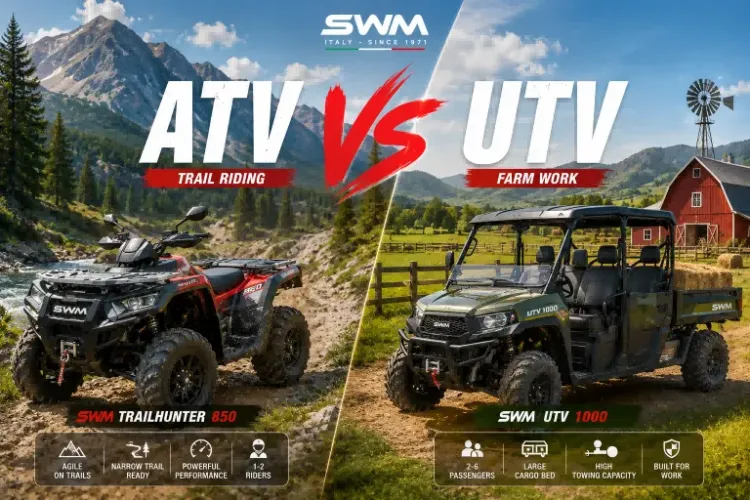
At a glance, the simplest way to tell them apart is how you ride them: you straddle an ATV like a motorcycle, but you sit in a UTV like a car.
1. What is an ATV? (All-Terrain Vehicle)
Commonly called a four-wheeler or quad, an ATV is designed for a single rider (though some models allow for a passenger riding tandem).
- How you drive it: You straddle a saddle seat and steer using handlebars. Throttle and braking are controlled by hand levers and foot pedals.
- Size & Agility: ATVs are compact. They can squeeze through tight, winding forest trails where larger vehicles would get stuck.
- Physically Active: Riding an ATV requires you to use your body weight to lean into turns and navigate rough obstacles. It's a highly engaging, active ride.
[caption id="" align="aligncenter" width="750"]
 ATV vs UTV[/caption]
What is a UTV? (Utility Terrain Vehicle / Utility Task Vehicle)
Commonly called a side-by-side (SxS), a UTV is a larger, heavy-duty vehicle built for hauling, working, or carrying multiple people.
- How you drive it: You sit in bucket or bench seats side-by-side. It features a steering wheel, gas pedal, brake pedal, and seatbelts—just like a standard car.
- Safety: Unlike ATVs, UTVs come equipped with a roll cage (ROPS - Rollover Protective Structure), hard doors or nets, and seatbelts.
- Payload & Towing: Most UTVs have a truck-like cargo bed in the back that can dump heavy loads, making them incredibly popular on farms, construction sites, and ranches.
Key Differences at a Glance
| Feature | ATV (All-Terrain Vehicle) | UTV (Utility Terrain Vehicle) |
| Seating Style | Straddle saddle seat | Side-by-side bucket/bench seats |
| Capacity | 1 rider (occasionally 2 with tandem seat) | 2 to 6 passengers |
| Steering | Handlebars | Steering wheel |
| Safety Features | Rider gear (helmet, boots, pads) | Roll cage, seatbelts, doors/nets |
| Main Use | Recreational trail riding, quick maneuverability | Heavy labor, towing, group trail riding |
| Footprint | Small and narrow (fits in a standard truck bed) | Large and wide (usually requires a trailer) |
| Average Cost | Generally more affordable ($6,000 – $16,000) | More expensive ($12,000 – $30,000+) |
Which One is Right for You?
Choose an ATV if
- You want a thrilling, athletic ride: If you like the physical challenge of maneuvering a machine over dirt tracks and technical trails, an ATV is unmatched.
- You ride solo: If you don't need to transport passengers.
- You are on tight trails: Many state parks have strict width limits (often 50 inches) on trails, which easily accommodate ATVs but block wider UTVs.
- You have a smaller budget or storage space: They fit easily into a garage corner or the bed of a pickup truck.
Choose a UTV if
- You have work to do: If you need to haul firewood, dump gravel, tow trailers, or carry heavy tools around a large property.
- You want to bring family or friends: UTVs make off-roading a shared, social experience.
- Safety is your top priority: The roll cage, seatbelts, and automotive-style seating provide a much more secure environment, especially for older adults or younger passengers.
- Comfort matters: You want to sit comfortably, perhaps even enjoy a heated cab, windshield, and stereo system while out on the trails.